

The role of a systems engineer has evolved rapidly over the past few years. In 2026, systems engineers are no longer evaluated only on uptime or infrastructure knowledge. You are expected to understand architecture, scalability, reliability, automation, and cost efficiency at a deep level.
As expectations rise, certifications have taken on a new role. They are no longer just résumé decorations. When chosen correctly, certifications signal structured learning, modern skill alignment, and long-term career intent.
The key phrase here is chosen correctly. Not all certifications provide the same value, and not all certifications make sense at every stage of your career.
This guide focuses on the best certifications for systems engineers in 2026, with a practical lens on System Design interviews, career growth, and real-world relevance.

What Certifications Actually Signal To Interviewers
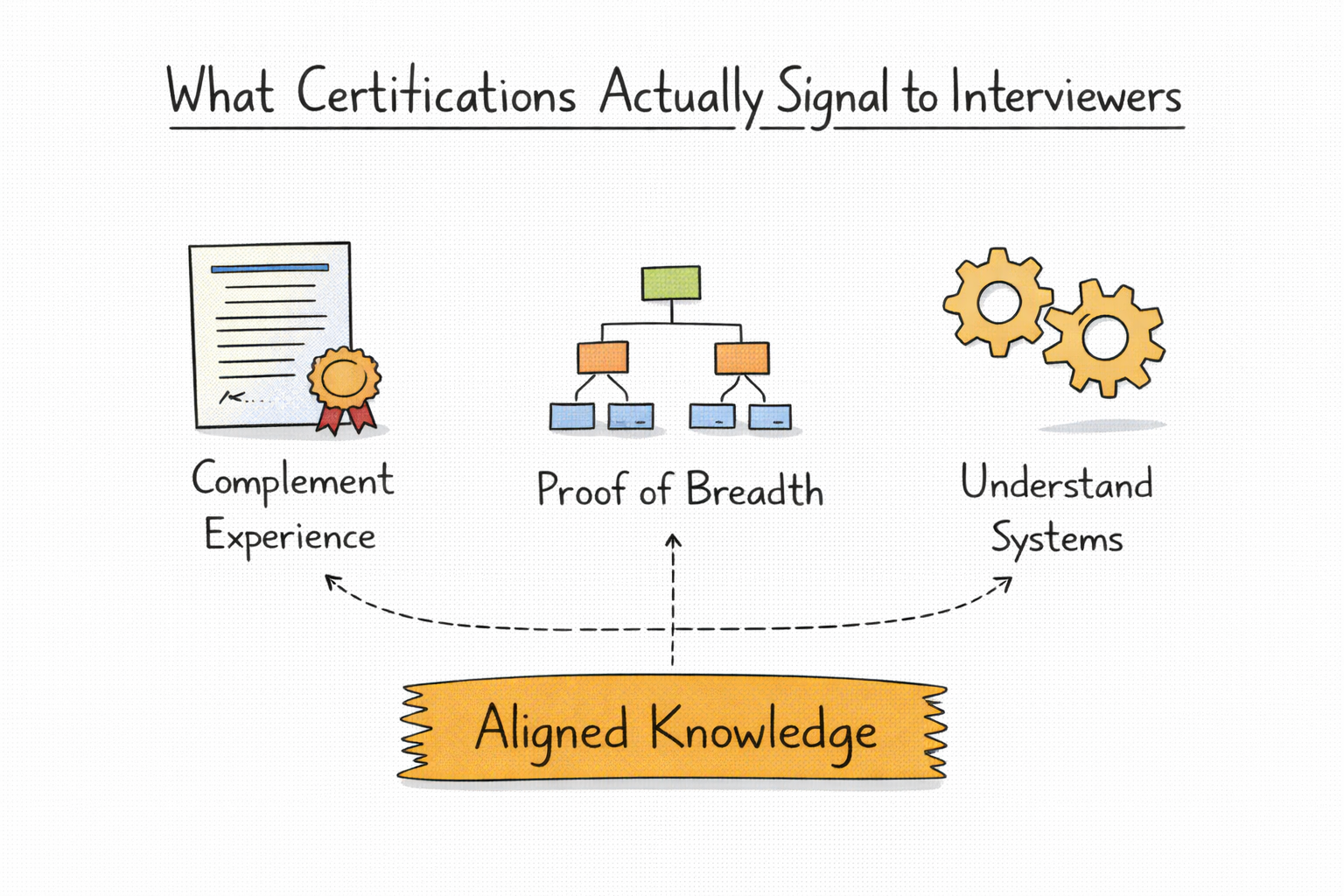
Before exploring specific certifications, it is important to understand what interviewers and hiring managers actually infer from them.
Certifications do not replace experience. They complement it. A certification signals that you understand a domain well enough to speak its language, reason about its trade-offs, and apply structured knowledge to real problems.
For System Design engineers, certifications often act as proof of breadth rather than depth. They show that you understand how systems fit together, even if you are still growing hands-on expertise.
The most effective certifications align closely with how systems engineering work is evaluated in interviews.
How To Choose The Best Certifications For Systems Engineers
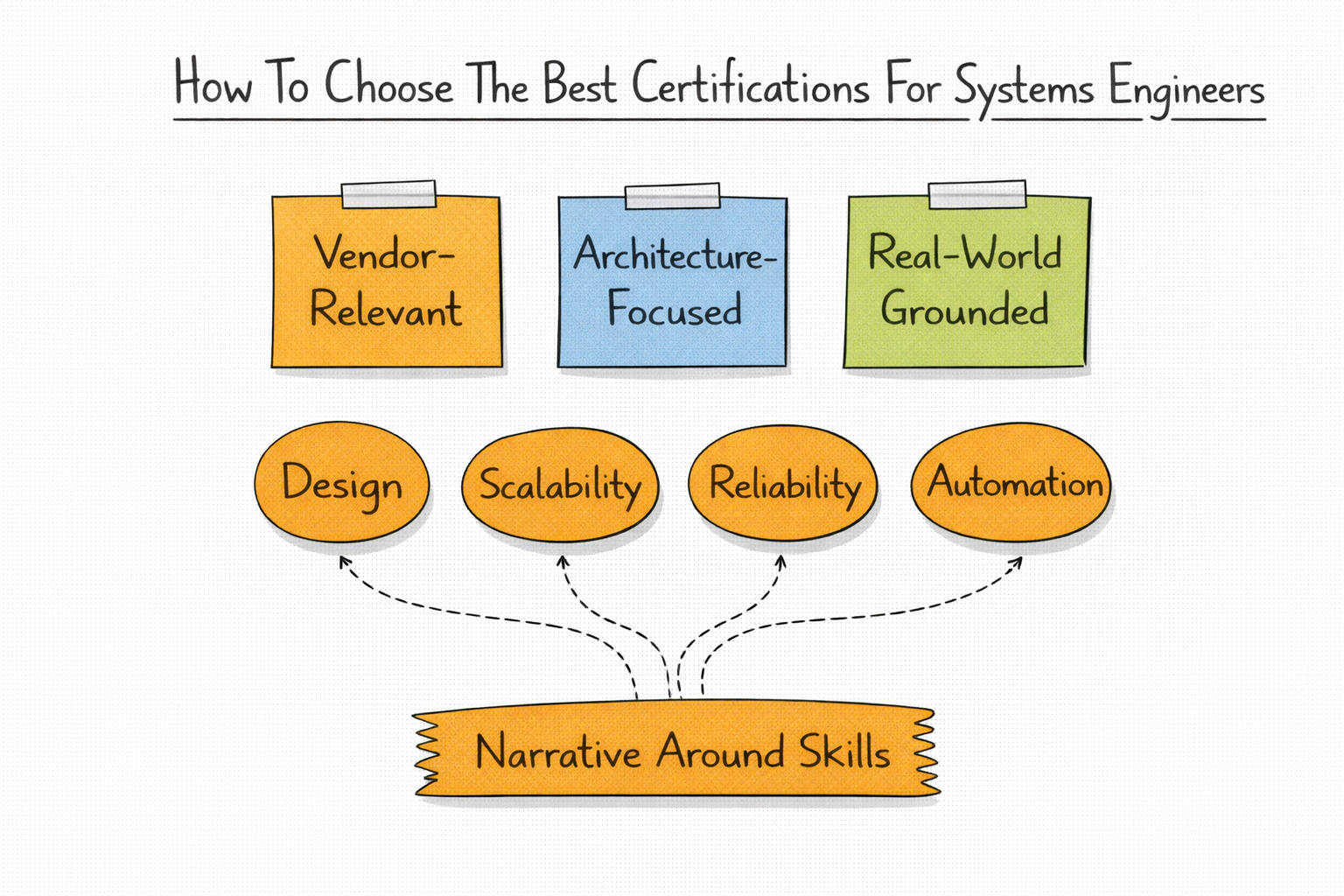
The best certifications for systems engineers in 2026 share a few characteristics. They are vendor-relevant, architecture-focused, and grounded in real-world system behavior.
Certifications that only test memorization or niche tooling provide limited value. Certifications that emphasize design decisions, scalability, reliability, and automation provide long-term returns.
Your goal should not be collecting certificates. Your goal should be to build a narrative around your skills.
1. AWS Certified Solutions Architect (Associate Or Professional)
This certification continues to be one of the most valuable credentials for systems engineers in 2026 because it aligns closely with how System Design is evaluated in interviews.
It forces you to think in terms of scalability, availability, fault tolerance, and cost trade-offs rather than isolated services. Interviewers recognize it immediately, and more importantly, they tend to probe architectural reasoning when they see it on your résumé.
If you are preparing for this certification with interview readiness in mind, courses that focus on architecture-first thinking matter more than service memorization.
Many engineers pair the certification with structured System Design learning, such as Educative’s Grokking the System Design Interview, while also using AWS’s official whitepapers and Well-Architected Framework for depth and realism.
This combination helps you connect certification concepts directly to interview conversations.
2. Google Professional Cloud Architect
The Google Professional Cloud Architect certification stands out for its emphasis on clean design and principled decision-making.
It rewards simplicity, clarity, and performance-aware architecture rather than overly complex solutions. This makes it especially relevant for systems engineers who want to demonstrate strong design judgment in interviews.
Engineers preparing for this certification often complement Google’s official documentation with broader System Design resources. Courses that focus on trade-offs, request flow, and scalability reasoning, such as System Design tracks or design-focused content from platforms like Coursera and A Cloud Guru, help bridge the gap between certification material and interview expectations.
3. Microsoft Azure Solutions Architect Expert
For systems engineers working in enterprise-heavy or hybrid environments, the Azure Solutions Architect Expert certification has become increasingly relevant.
It emphasizes integration, identity management, reliability, and large-scale system coordination. Interviewers often associate this certification with experience handling real-world complexity rather than greenfield systems.
Candidates preparing for this certification frequently mix Microsoft Learn paths with broader architecture discussions. O’Reilly’s cloud architecture resources help place Azure services into a vendor-neutral design mindset, which is exactly what interviews reward.
4. Certified Kubernetes Administrator (CKA)
Kubernetes knowledge is no longer optional for systems engineers in 2026. Even if you do not manage clusters daily, you are expected to understand how container orchestration affects scalability, deployment, and failure handling.
The CKA certification signals strong distributed systems awareness. It also maps well to System Design interviews, where concepts like stateless services, replicas, and rolling deployments appear frequently.
Many engineers prepare for CKA using a mix of hands-on labs, Kubernetes documentation, and conceptual learning. Courses that explain why orchestration decisions matter, such as Educative’s Kubernetes content, pair well with more operational platforms like KodeKloud or Linux Foundation materials.
5. Certified Kubernetes Application Developer (CKAD)
While the CKA focuses on cluster administration, the CKAD focuses on how applications behave inside distributed systems.
For systems engineers who work closely with developers, this certification demonstrates a strong understanding of application design constraints in scalable systems.
Interviewers often explore these ideas indirectly when asking about statelessness, configuration management, and deployment strategies. Learning resources that emphasize application behavior within distributed systems, including official Kubernetes learning paths, help translate CKAD knowledge into interview-ready explanations.
6. HashiCorp Terraform Associate
Infrastructure as code has become a baseline expectation rather than a bonus skill.
The Terraform Associate certification signals an automation mindset and operational discipline. It tells interviewers that you design systems that are reproducible, auditable, and scalable.
Candidates often combine Terraform certification prep with broader infrastructure design learning. Pairing Terraform study with DevOps-oriented System Design courses, along with HashiCorp documentation and community examples, helps reinforce why automation choices matter architecturally.
7. Cisco Networking Certifications (CCNA Or CCNP)
Despite higher-level abstractions, networking fundamentals remain critical for systems engineers.
Cisco certifications still signal a strong understanding of traffic flow, routing, and failure modes. These skills surface during interviews when discussing latency, load balancing, or incident scenarios.
Engineers often reinforce networking certifications with System Design-focused learning to avoid staying purely theoretical. Combining CCNA or CCNP preparation with networking-focused resources from platforms like Pluralsight helps connect packet-level knowledge to architectural reasoning.
8. Cloud Security Certifications
Security is no longer a separate concern. It is embedded in System Design.
Security-focused certifications signal that you understand access control, encryption, and blast radius as architectural decisions rather than afterthoughts.
Preparing for these certifications works best when paired with System Design thinking. Many engineers study security concepts using official cloud provider materials while reinforcing design trade-offs through security architecture content from platforms like Cybrary.
This combination helps you discuss security naturally in interviews instead of treating it as a checklist.
9. Site Reliability Engineering Certifications
Reliability engineering principles have become mainstream expectations for systems engineers.
Certifications that emphasize monitoring, incident response, and service-level objectives signal operational maturity. Interviewers often probe these areas implicitly when asking about failure handling.
Engineers often pair SRE-focused certifications with System Design learning to connect reliability metrics to architectural decisions. Google SRE books or Linux Foundation resources provide strong conceptual grounding.
Distributed Systems And Data Certifications
Certifications focused on distributed data systems signal a deep understanding of consistency, replication, and performance trade-offs.
These topics appear frequently in System Design interviews involving feeds, messaging systems, or large-scale storage.
Engineers often complement such certifications with System Design walkthroughs. Using database-specific courses from Coursera or vendor documentation helps build both breadth and interview fluency.
How These Certifications Compare At A Glance
| Certification Category | Primary Signal | Interview Relevance |
| Cloud Architecture | Design judgment | Very high |
| Kubernetes | Distributed systems thinking | High |
| Infrastructure As Code | Automation mindset | Medium to high |
| Networking | Strong fundamentals | Medium |
| Security | System maturity | High |
| Reliability | Operational awareness | High |
This comparison helps you choose certifications strategically rather than collecting them blindly.
Comparing Certifications By Career Stage
Not all certifications make sense at every stage of your career. The best certifications for systems engineers depend on where you are now and where you want to go.
The table below shows how certification value changes by career stage.
| Career Stage | Certification Focus |
| Early Career | Cloud fundamentals and architecture |
| Mid-Level | Platform, orchestration, reliability |
| Senior | Architecture, security, leadership |
This perspective helps you avoid over-investing in certifications that do not align with your goals.
How Certifications Impact System Design Interviews
Certifications do not guarantee success in interviews, but they change the conversation.
Interviewers often probe deeper when they see relevant certifications. They assume a baseline level of understanding and ask more nuanced questions.
This can be an advantage if you truly understand the material.
Certifications are most effective when paired with clear reasoning and communication.
Common Mistakes When Pursuing Certifications
One common mistake is chasing too many certifications too quickly. Another is choosing certifications based solely on popularity rather than relevance.
Some candidates treat certifications as shortcuts. Interviewers quickly detect shallow understanding.
Certifications should support learning, not replace it.
How To Combine Certifications With Real Experience
The strongest systems engineers use certifications as structured learning frameworks.
They study concepts, apply them at work or in projects, and then validate their understanding through certification exams.
This approach builds durable skills rather than superficial knowledge.
Are Certifications Required To Be A Successful Systems Engineer?
No certification is mandatory. Many excellent systems engineers hold none.
However, certifications can accelerate learning, improve interview performance, and signal seriousness about your career.
In competitive markets, they can be differentiators.
Final Thoughts On The Best Certifications For Systems Engineers In 2026
The best certifications for systems engineers in 2026 are not about titles. They are about alignment.
Certifications that emphasize architecture, scalability, reliability, and security align most closely with modern systems engineering roles.
Choose certifications that support your learning goals, reinforce your System Design thinking, and complement real-world experience.
When chosen thoughtfully, certifications become tools for growth rather than checkboxes.